

A one-day pilgrimage itinerary to St Louis Cathedral

Wherever we guide pilgrims, either locally or internationally, there’s a practical phrase I find myself repeating: “Look for the church.” This is usually to establish a group meeting point because old cities are generally built around a central church. Spires and bell towers rise above the skyline, making the church easy to spot from wherever you are. But the centrality of “look for the church” carries another, deeper meaning: the church is the heart of human civilization.
St Louis Cathedral is the oldest continuously operating cathedral in the United States. As the heart of New Orleans from the beginning, the cathedral holds unique historic significance in the American Catholic Church. Here, the Ursuline Sisters worshipped while they established the nation's very first Catholic school. Here, a host of beati and saints prayed, received sacraments, were baptized, or stood as godparents. And the first American pope, Leo XIV, has a very close personal connection to the country’s oldest cathedral (keep reading!).
The cathedral has survived hurricanes, fires, epidemics, and wars (even Mardi Gras)—built and rebuilt through the centuries. Whether you are local or a visitor, you can make a one-day pilgrimage to this profoundly significant place of Catholic heritage. Here’s the itinerary:

Begin with coffee.
Start your morning at French Truck Coffee on Chartres Street, only a few blocks from the cathedral. Take your cafe au lait to Jackson Square’s iron benches for a view of the cathedral’s triple-spired façade. For centuries, that same silhouette has been the first thing colonists, immigrants, generals, pilgrims, presidents, and popes saw as they entered New Orleans from the Mississippi River. If you need beignets, stop in at our favorite, Café Beignet on Royal Street.

Arrive at the cathedral exterior.
The cathedral you see today was largely rebuilt in the 1850s, with only a little of the original 1789 Spanish structure remaining. But the site of worship itself goes back to the first days of the colony. In 1718, when the first French settlers arrived, they pitched camp right where you're standing and constructed a small wooden church. The cathedral marks the birthplace of New Orleans.
After the Great Fire of 1788, rebuilding was funded largely by Don Andrés Almonaster y Rojas, a Spanish nobleman. You’ll see his tomb inside, beneath the floor near the right side altar. (His daughter, Baroness Pontalba, shared his passion for building; she constructed the famous twin Pontalba Apartments that border Jackson Square.) A charming note: according to French custom, the cathedral’s bell has a name engraved on its face: Victoire.

Pray at the original baptismal font.
Originally kept in a side chapel, the baptismal font now stands on the side of the main altar. This font is the oldest original element of the cathedral. It survived the Great Fire of 1788 that destroyed everything else. Generations of New Orleans families have carried their babies to this font. In 1840, one local free Black family brought their infant daughter to be baptized here. In 2025, her great-grandson would be elected Pope Leo XIV.
Connect with saints and popes.
For a hundred years or so, the cathedral was the city’s only house of worship. All the saints who lived and worked in New Orleans—Venerable Henriette Delille, St Frances Cabrini, St Katharine Drexel, Blessed Francis Seelos—came here for their sacramental life. In 1964, Pope St Paul VI elevated the cathedral to a minor basilica (hence its fancy name: Cathedral-Basilica of St Louis, King of France). In 1987, Pope St John Paul II prayed at the statue of Our Lady of Prompt Succor.


Contemplate important features inside.
There are countless fascinating and significant features and events to contemplate inside. If you’d like a deeper detailed tour, the cathedral is a primary stop on our New Orleans stillgrimage route. (Let’s talk!) You can also look for the following:
The Henriette Delille prayer room: Just off the entrance, the former baptismal font room is now dedicated to Venerable Henriette Delille. Born a free person of color in 1812, she devoted her life to serving the city’s enslaved and eventually founded the Sisters of the Holy Family, the second oldest religious order for Black women in the United States. Mother Henriette worshipped in the cathedral her whole life.
The floors: More than 100 people are buried beneath the cathedral floor, including twelve bishops and archbishops among them. Graves are often positioned facing the altar so that the current archbishop may contemplate his eternal destiny. P.S. If you come along with me, I’ll show you where fossils are embedded in the center aisle tiles.
A Spanish royalty connection: Near the right side altar hangs one of the oldest crucifixes in the United States. It has a connection to the kings of Spain. P.S. Fun fact: Another king of Spain (Felipe VI) visited the cathedral in 2018 to celebrate the city’s tricentennial.
The ceiling, windows, and a Paris connection: The ceiling frescoes aren’t actually painted on plaster. After New Orleans’ relentless humidity destroyed multiple previous frescoes, the current ones were painted on canvas and then attached to the ceiling. Circling the pews, intricate stained glass windows tell the life of St Louis IX of France from birth to death. P.S. St Louis commissioned the Sainte-Chapelle in Paris, one of the most breathtaking buildings in the history of Western civilization, built to house the Crown of Thorns. One of the cathedral’s windows depicts Louis designing Sainte-Chapelle.

Visit Our Lady of Prompt Succor.
On the left side altar is a gold statue of Our Lady of Prompt Succor. Since arriving with the Ursulines in 1727, she has been the city's patroness and most beloved intercessor. Her prayers are credited for dozens of miracles, including Andrew Jackson's inexplicable victory at the Battle of New Orleans on January 8, 1815. On every January 8 since then, a Mass of thanksgiving has been offered at the cathedral and her shrine Uptown. Andrew Jackson himself thanked the Ursulines for leading the vigils to Our Lady, which he said were critical to victory.
Stop in the gift shop.
Before Mass, visit the cathedral gift shop for special medals, religious articles, books, and local Catholic items. (It’s a good way to support the major restoration currently needed to maintain the cathedral.)
Go to Mass.
This itinerary is centered around weekday Mass at 12:05 p.m. On Saturdays, reverse the itinerary to begin with Mass at 8:00 a.m.
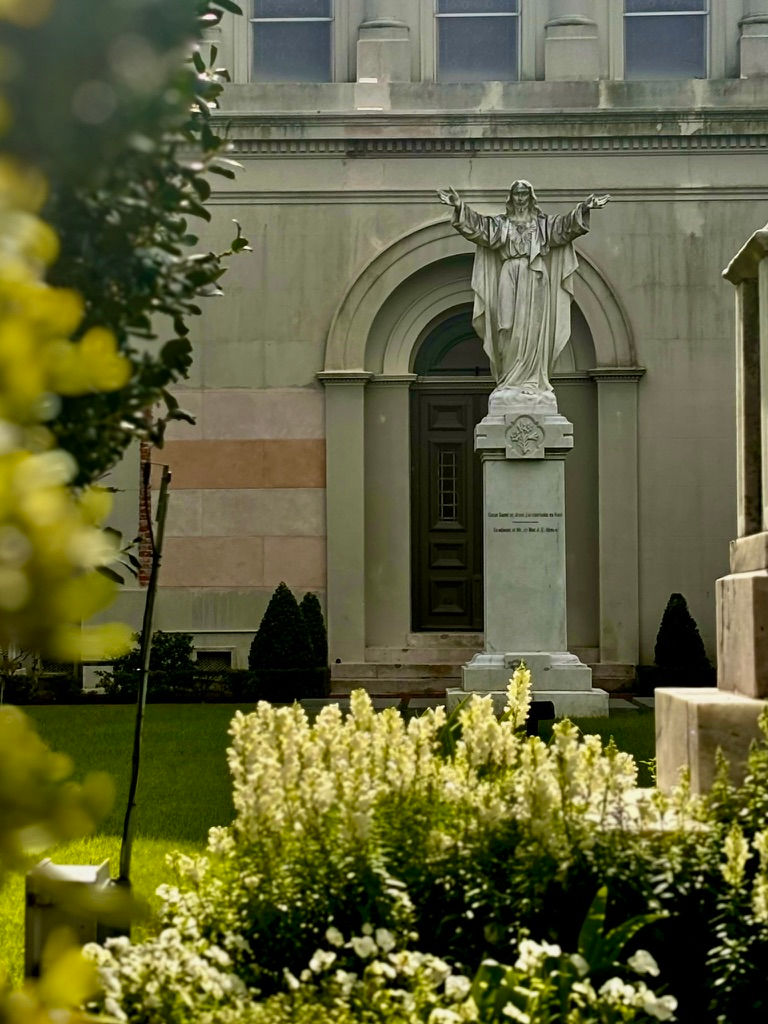
Visit the Katrina Jesus statue.
Before you head to lunch, walk around to the back of the cathedral to St Anthony’s Garden. A marble statue of Jesus stands with arms outstretched. Hurricane Katrina broke off several fingers, which remained intentionally unrepaired until the city was rebuilt. They were restored and reconsecrated in 2015 on the tenth anniversary of the storm.
Enjoy an amazing lunch.
There are ten million places to eat, so let’s narrow down a few options that are a short walk from the cathedral:
Mena's Palace: budget-friendly, unpretentious, and delicious plate lunches
Croissant d'Or: pastries, quiche, espresso in a European café atmosphere
Jimmy J’s : ridiculous omelettes and sandwich masterpieces in a tiny, quirky setting
Cafe Amelie: elevated Creole dishes and a romantic French Quarter courtyard

How to get to St Louis Cathedral
Address: St Louis Cathedral, 615 Pere Antoine Alley, New Orleans
Mass times:
Monday–Friday: 12:05 p.m.
Saturday: 5:00 p.m. (Vigil) Note: This Mass time will change to 4:00 p.m. after July 4, 2026.
Sunday: 9:00 a.m., 11:00 a.m.
Confession:
Monday–Friday: 11:30 a.m.-12:05 p.m.
Saturday: 4:15-4:45 p.m
Admission: Free; consider leaving a donation to the cathedral campaign
Access and parking: There is no parking at the cathedral. If you drive, park in a public lot (there are dozens in the French Quarter–I use Spot Hero). If you have more time, park somewhere along the St Charles Avenue streetcar route and ride the streetcar downtown.
Recommended time: 1–2 hours inside, plus garden
Recommended ages: All ages — see our tips for visiting churches with young people here
Would you like to tour the rich sacred heritage of New Orleans? Thy Ship offers custom stillgrimages and pilgrimage experiences for families, schools, parishes, and groups. Let's talk!


Comments